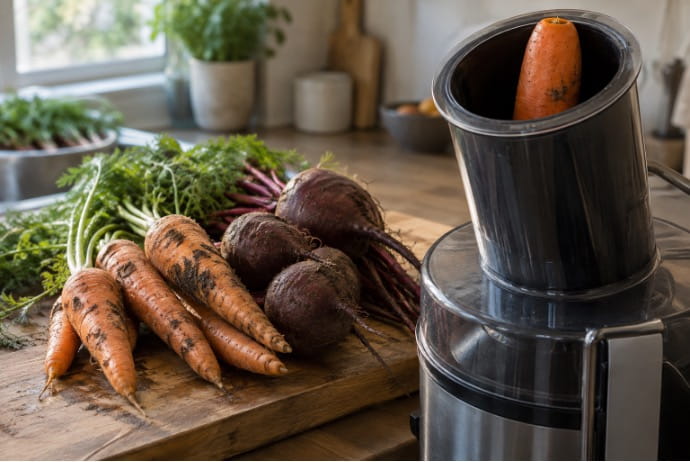
Carrots and beets are the two vegetables that expose a cheap juicer fastest. They’re dense, fibrous and low in free water, so a machine that breezes through oranges and cucumbers will bog down, heat up, and hand you a cup of foam sitting on top of thin pink liquid.
If root juice is the reason you want a juicer at all, the choice narrows quickly. Here’s what separates the machines that cope from the ones that struggle.
Cold press or centrifugal juicers
Centrifugal juicers shred produce against a fast-spinning disc and fling the juice outward through a mesh screen. They’re quick, and they rarely clog with roots because pulp is ejected continuously. The trade-off is wetter pulp, more foam, and juice that separates in the fridge within hours.
Cold press (masticating) machines crush produce slowly with an auger. Typical speeds sit around 55 RPM, which is slow enough to avoid heating the juice and slow enough to squeeze hard roots properly.
For carrots and beets specifically, the yield gap is the argument. Cold press models commonly return 85 to 99 percent of the available juice, while centrifugal machines land closer to 70 to 85 percent. On expensive organic produce, that difference shows up in your grocery bill.
Motor power that won’t stall on a beet
Wattage alone tells you little, because the two types use it differently. A centrifugal motor might be rated 700 to 850 watts purely for speed; a cold press auger can do heavier work at 150 to 400 watts because it has torque rather than RPM.
What matters is that the motor doesn’t stall mid-beet. Below roughly 100 watts, slow juicers tend to slow down and clog on fibrous roots. Noise follows the same logic: fast spinning discs are loud, augers hum. If you juice early in a small flat, that’s not a trivial detail.
The feed chute: the part people underestimate
A three-inch chute takes medium carrots and whole apples. Chutes in the 5.8 to 6.5 inch range swallow larger roots with almost no knife work, which can cut carrot prep from five minutes down to one or two.
You’ll still halve a very large beet, both for speed and for safety. But standard narrow chutes mean chopping every single root, and that’s the step that quietly kills a juicing habit by week three.
Reading through a side-by-side comparison of the best juicer for carrots makes the pattern obvious: the machines that accept whole roots are the ones owners report using several times a week, while narrow-chute models tend to sit in a cupboard.
What the pulp tells you after a carrot run?
Once you own a machine, the pulp tells you everything. Squeeze a handful after a carrot run. If it’s crumbly and barely stains your palm, extraction is good. If it’s heavy and wet, you just threw away juice.
A few design details help here:
- A two-stage auger with a pre-chopping blade handles tough roots before the main crush
- A reverse function pulls back material that wedges in the auger
- Dual-layer fine mesh strainers (around 0.3mm) reduce clogging from the filter side
- Interchangeable pulp filters let you choose between thin juice and a thicker texture
- A safety lock that cuts the motor when the lid opens, useful when you’re clearing a jam
Cleaning up beet stains without a fight
Beet juice stains, and carrot fibre wedges into mesh. The juicer you’ll keep using is the one you can take apart, rinse and reassemble in under five minutes.
Traditional centrifugal baskets often need a brush and sometimes a toothpick to clear packed fibre from the screen. Auger-based models with dishwasher-safe parts generally rinse clean under the tap. Anti-drip levers and one-button disassembly sound like marketing filler until you’ve mopped beet juice off a counter twice.
The pulp test is the cheapest diagnostic you’ll ever run on a juicer: dry, crumbly pulp means the auger earned its keep, wet pulp means juice went down the drain. Buy for that outcome rather than for a spec sheet, and the carrots and beets will tell you whether you got it right every time you juice them.