
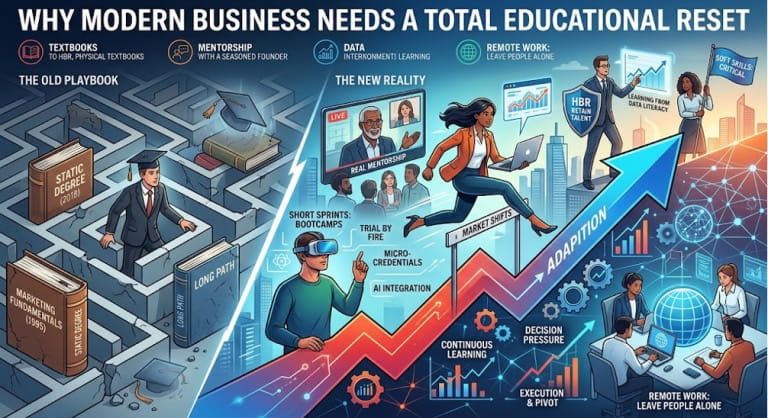
The old playbook for success is officially dead. For years, the path was simple: get a degree, land a job, and coast for thirty years. Today? That approach gets you left behind fast. The connection between education and business moves way too quickly for static textbooks, and anyone trying to scale an enterprise has to adapt on the fly.
Learning isn’t a one-and-done deal anymore — it’s a constant survival skill.
The Problem with Traditional Degrees
Let’s be honest. Most four-year university courses are out of date before students even graduate. Studying marketing strategies from 2018 doesn’t help much when you’re suddenly managing automated ad funnels, shifting algorithms, and AI tools in a live workplace.
That’s why real-world corporate training and flexible learning have taken over. According to insights on lifelong learning from UNESCO, formal degrees are just a starting point now. The real growth happens through quick, hands-on micro-credentials and actual execution.
- Short sprints: Ditching long degrees for fast, targeted skill bootcamps.
- Real mentorship: Learning straight from active founders instead of career academics.
- Trial by fire: Building real projects where making mistakes doesn’t cost your entire career.
Taking Smart Risks and Making Sharp Calls
Running a business usually comes down to making calls before you have the full picture. If you wait for 100% certainty every time, you’ve already missed the window.
You see that same instinct in surprising spots. Smart operators like to test their reaction time in environments where the landscape shifts every second. Spending time on dynamic platforms like 20Bet comes down to the same basic mechanics: sizing up the odds, keeping your cool when things get chaotic, and making a decision without second-guessing yourself. Managing your capital on a new launch or pulling the plug on a failing project takes that exact same grit.
Keeping People by Teaching Them
Big paychecks don’t lock down good people the way they used to. When sharp people interview for a job, they usually care about one main thing: Will I actually learn anything useful here, or will my skills just rot?
Companies that treat staff development like an HR checkbox end up watching their best talent walk out the door. The ones that actually help their people level up keep them around. Reporting from the Harvard Business Review backs this up repeatedly—businesses that give their workers room to learn keep their people longer and handle market shocks without falling apart.
Building in Public
The line between executive and teacher has completely blurred. The best founders aren’t hiding in boardroom meetings — they’re out in the open, teaching what they know through podcasts, posts, and breakdown videos.
Sharing your wins and your failures builds instant trust with customers. People want to buy from brands that actually teach them something useful, making education one of the strongest marketing tools in modern business.
Reading the Numbers
Everyone’s swimming in spreadsheets, but almost nobody actually knows what to look at. If a manager can’t make sense of basic performance metrics these days, they’re just guessing.
Groups like the World Economic Forum keep reminding us that reading data is basic literacy now. Still, charts only show you what already happened. The real magic is knowing when to trust the numbers and when to rely on plain old common sense.
The companies that win next aren’t the ones burning through cash—they’re the ones that figure stuff out fast and pivot without making a drama out of it.
Soft Skills Outlast Any Software
Most business tools you use today won’t exist in ten years. The tech just moves too fast. But knowing how to handle a pissed-off client or calm down two teammates arguing over a project? That never gets old. People get so wrapped up in technical skills that they forget basic human communication is usually what gets you hired and promoted.
Real Remote Work Means Leaving People Alone
Setting up a Slack workspace isn’t management. When you can’t tap someone on the shoulder, minor mix-ups get out of hand fast, but watching green status dots all day only makes things worse. It just signals that you don’t trust the people you hired. The managers who actually pull off remote work lay out the goals, set a deadline, and then get out of the way. If you have to babysit someone’s online status to make sure they’re working, you hired the wrong person—or you’re just bad at delegating.
Pick a Specific Problem for a Specific Person
If you try to build something for everyone, nobody buys it. The pitch ends up so generic that it blends right into the background noise. It’s much smarter to find ten or twenty people who are completely frustrated with a very specific problem, build something that fixes it for them, and ignore everyone else for a bit. Once you make a small group extremely happy, they’ll do the marketing for you. Big audiences come later—you have to get a few die-hard fans first.
Working Yourself to Death Isn’t a Flex
Bragging about 80-hour workweeks is just dumb. Sure, you might get a lot done for a month, but pretty soon your brain turns to fried eggs and every decision you make sucks. Resting isn’t being lazy. If you never turn your brain off, you won’t have any good ideas left to execute anyway.
Just Get It Out the Door
You can spend weeks tweaking slides, arguing over feature lists, and perfecting a product roadmap. It feels like real work, but it’s mostly just procrastination. The market doesn’t care about your internal notes; it only reacts to what’s actually live. Getting a rough version into real hands beats sitting on a “perfect” idea every single time, because real users will tell you what’s broken ten times faster than any internal meeting ever could.
Stop Overthinking Every Hire
Companies drag out interview processes for months, doing six rounds of talks and endless personality tests just to fill a basic role. It’s a complete waste of time. You never actually know how someone works until they’re in the trenches with you, handling real deadlines and messy projects. Hire people fast on small, paid test projects first. If it works out, bring them on; if it doesn’t, part ways and move on instead of wasting half a year trying to find a unicorn candidate that doesn’t exist.


