
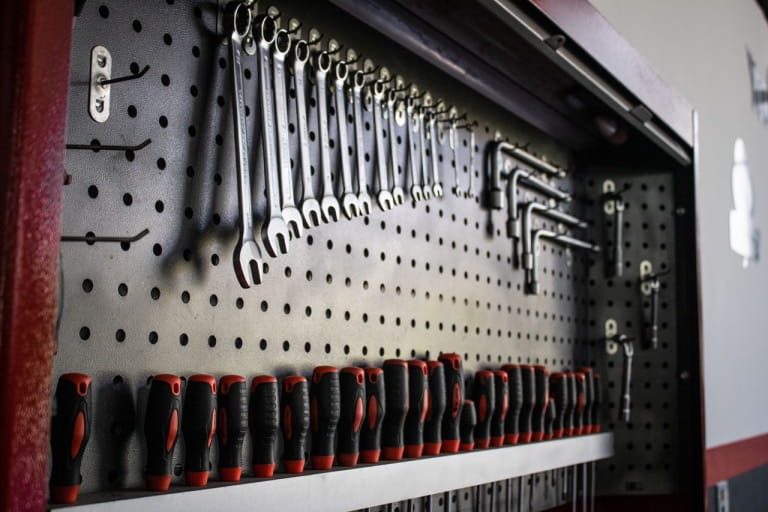
Most homeowners pick a tool storage spot based on which wall is empty. That decision often becomes a permanent one that will reappear years down the line as rusted chisels and dead battery packs. Some tools are better to store in the basement, others in the garage, so which tools belong where? Here’s how to make that call based on climate, access, safety, and the work you actually do.
What Your Tools Need From a Storage Space?
The number one cause of tool damage is moisture. Rusting starts rapidly when relative humidity stays above around 50 percent and accelerates when warm, moist air comes into contact with cold metal. This is the same film of condensation you see on your car’s windshield in the morning, and that’s what forms on a cast iron saw table overnight.
Batteries and finishes impose further limitations. In fact, lithium-ion packs, such as those from DeWalt and Milwaukee, tend to hold up better when stored between 40°F and 100°F, and many chargers delay charging pack that’s too cold. A hard freeze can destroy glues, latex paint, and caulk. Before comparing rooms, write down what you own and what each item can tolerate.
Small items need a plan too. Screws, nails, drill bits, and fittings get lost or rust fast when they’re tossed into open bins, so a parts cabinet with multiple drawers keeps them dry and sorted. It also takes up less than 2 square feet of wall or bench space, which makes it easy to fit in either room.
The Basement: Stable Conditions, Tight Access
Climate You Can Control
Since a basement is below grade, it often stays within a few degrees of the rest of the house, year-round. That’s why hand tools, measuring instruments, and battery packs do well down there.
The downside of this is humidity. In summer, many basements run 60 to 70 percent humidity, and it will rust exposed plain iron in a couple of weeks. A 50-pint dehumidifier with a drain to a sump or floor drain, programmed to operate at 45 percent, will satisfactorily address most issues. Use a hygrometer to measure the actual reading.
Security and Convenience
The tools are behind the locks and alarm in your home’s basement. If your garage door faces the street, it’s a big deal because passersby can see what’s inside, and cordless kits are easy to resell.
You will also have a shorter walk, too. If a cabinet hinge is lost or a shelf needs to be hung, you’ll use a drill on the lower floor. One stored in a cold garage waits until the weekend.
Where Basements Fall Short?
The largest issue is the stairs. It can be cumbersome and dangerous to take a 60-pound miter saw or a loaded toolbox down a tight staircase, and a full 4×8 sheet of plywood often won’t make the turn at all.
There are several other factors to consider before going all the way down to the basement:
- Flooding: do not place anything on the ground; use shelves or panels near the walls.
- Dust: sawdust gets pulled into furnace returns and distributed throughout the house.
- Fuel: no gasoline or gas engines near the furnace or water heater.
- Noise: a router running at around 100 decibels carries through floor joists to the rooms above.
The Garage: Room to Work, Harder to Protect
Space and Easy Loading
A typical two-car garage provides about 400 square feet, a large door, and a flat driveway access. A contractor can roll out a saw on a mobile base, cut plywood on sawhorses, and unload lumber from a truck bed directly onto the saw.
Heavy, dirty equipment is best suited to that sort of access. Pressure washers, wheelbarrows, ladders, lawn mowers, and air compressors are used outside and should be kept near the door they use.
Fuel and Fumes
Keep gas-powered tools and fuel cans out of the basement. Gasoline vapor is heavier than air and will settle, allowing a water heater burner or furnace igniter to get to it. In addition, many local fire codes limit the amount of gasoline you can store in an attached garage, typically 25 gallons in approved containers. Check your local code.
The same applies to finishing work, which is often done in the garage. Oil-based stains, spray paint, and lacquer emit fumes you don’t want to be in the bedroom; open the garage door for cross-ventilation. Lay oily rags on something to dry them or store them in a sealed metal can, as they can heat up and catch fire.
Where Garages Fall Short?
Without insulation, the garage temperature will closely mimic the outside. It can drop to 20°F at night in a cold climate and rise quickly on a sunny afternoon. These swings cause cast iron and hand tools to rust.
It’s no less true in summer: batteries don’t like heat, and an attached garage can reach 110°F in July. You can reduce swings by using an insulated garage door, a new weather-strip, and even a little dehumidification during the summer. For non-climate-controlled garages, store batteries, glues, and finishes inside the home.
How to Split Your Tools Between the Two?
For most houses, the best setup uses both spaces. Assign each tool based on its requirements, not where space is available.
Have three questions for each item. Heavy or bulky? Does it burn fuel or spark a lot of dust? Will it handle large temperature fluctuations? Typically your answer will look something like this:
- Basement: Hand tools, measuring and layout tools, chisels and planes, cordless batteries and chargers, drill and driver kits, glues and water-based finishes.
- Garage: lawn and garden equipment, gas engines and fuel, ladders, air compressors, large stationary saws and oil-based finishes.
Storage Habits That Protect Tools in Either Space
No matter how much room you have, good habits count. When using metal surfaces, clean them after use, as the salt and oil from your skin can cause rust spots in just a few days. A thin coat of paste wax on cast iron tables and a few silica gel packs in each drawer take care of the rest.
In both rooms, wall storage is better than floor storage. Tools should not be wet, hidden in cabinets, or lying in standing water or car bumper, or both. Most manufacturers recommend storing batteries at about 50% charge (half charge) for long periods of inactivity.
The basement is best for precision tools and batteries, and the garage for weight, fuel, and mess. If you only have one of these areas, keep the garage dry and warm and the basement uncluttered and easy to access, or make it easy to reach the basement if it is fuel-free and dry. A hygrometer, dehumidifier, and a couple of wall cabinets are not as expensive as buying a new hand plane that is rusted or a new battery pack that has gone bad.


